Events

Previous Events
Rachel Lipson Guest Talk
October 1, 2025
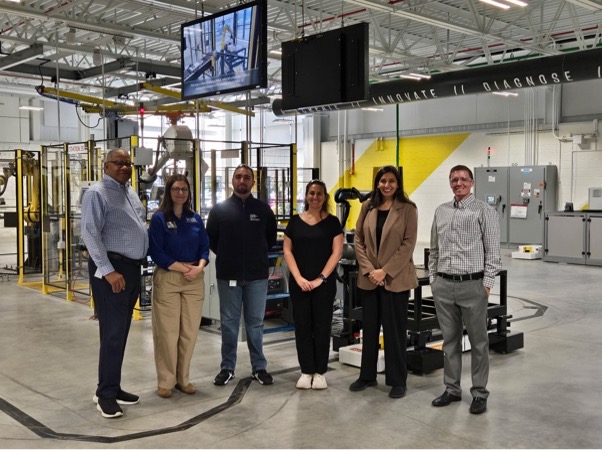
We welcomed Rachel Lipson, who is a Research Fellow at Harvard's Mossavar-Rahmani Center for Business and Government and founding director of the Harvard Project on Workforce. She is the co-editor of the Harvard Education Press volume America's Hidden Economic Engines: How Community Colleges Can Drive Shared Prosperity. Rachel discussed her new project, the New American Frontier, which explores a new generation of technical jobs—many fueled by AI and other emerging technologies—that do not require a four-year degree. A key premise of the project is that U.S. education and training systems have been too focused on desk jobs, rather than the hands-on, technical roles that are resilient to AI, critical to national security, and driving growth in emerging industries—like electricians, production and maintenance technicians, welders, and HVACs. The book will draw on examples from domestic "frontier regions" that have been early movers in the production of key technologies like AI data centers, semiconductors, quantum computing, clean energy, aerospace, biomanufacturing, and electric vehicles. It will use the experience of these regions to show which kinds of jobs are emerging, what it takes to prepare workers for these roles, and how leaders can invest in policies that align with strategic industries and expand access to good jobs.
Sarah Fox Guest Talk
April 18, 2025
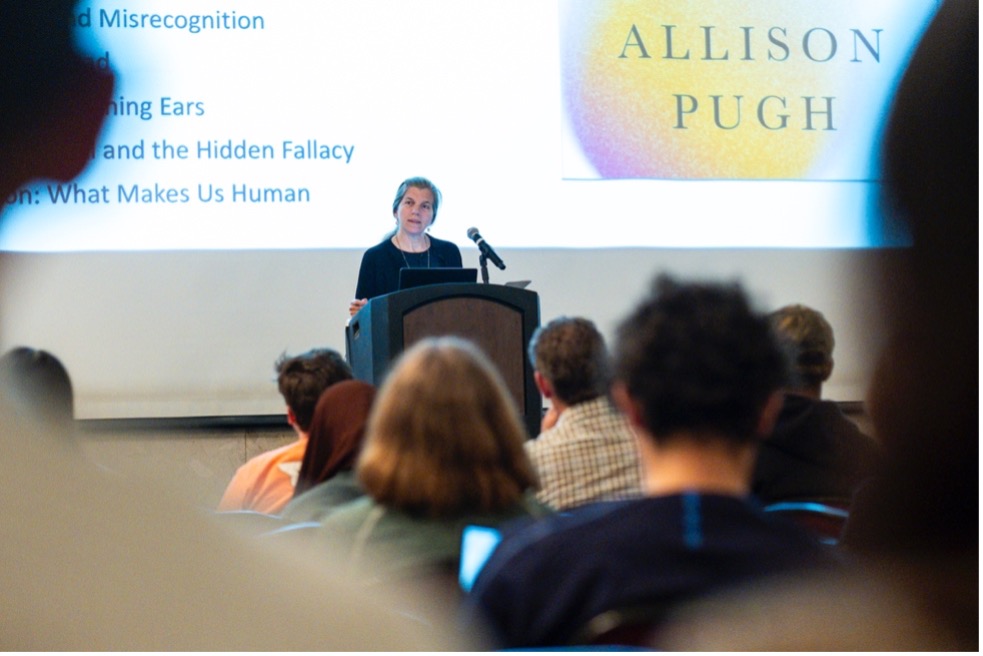
We welcomed Dr. Sarah Fox, who spoke about worker-centered design. Worker-centered design is an approach that emphasizes the well-being and input of employees, aiming to enhance not only productivity but also cooperation, autonomy, and fulfillment. Drawing on ongoing ethnographic and design research, she discussed two distinct cases in sectors facing different forms of technological change: 1) public transportation, for which autonomous vehicle technologies are being developed; and 2) hospitality, which regularly employs algorithmic management. Across these sites, Dr. Fox described labor-aligned efforts to evaluate the impacts of AI technologies on work practices and to develop methods and tools to ensure that working people have a voice in the creation, integration, and governance of technologies in their workplaces. Dr. Fox is an Assistant Professor at Carnegie Mellon University in the Human Computer Interaction Institute, where she directs the Tech Solidarity Lab.
2024 Future of Work Convening
March 8, 2024
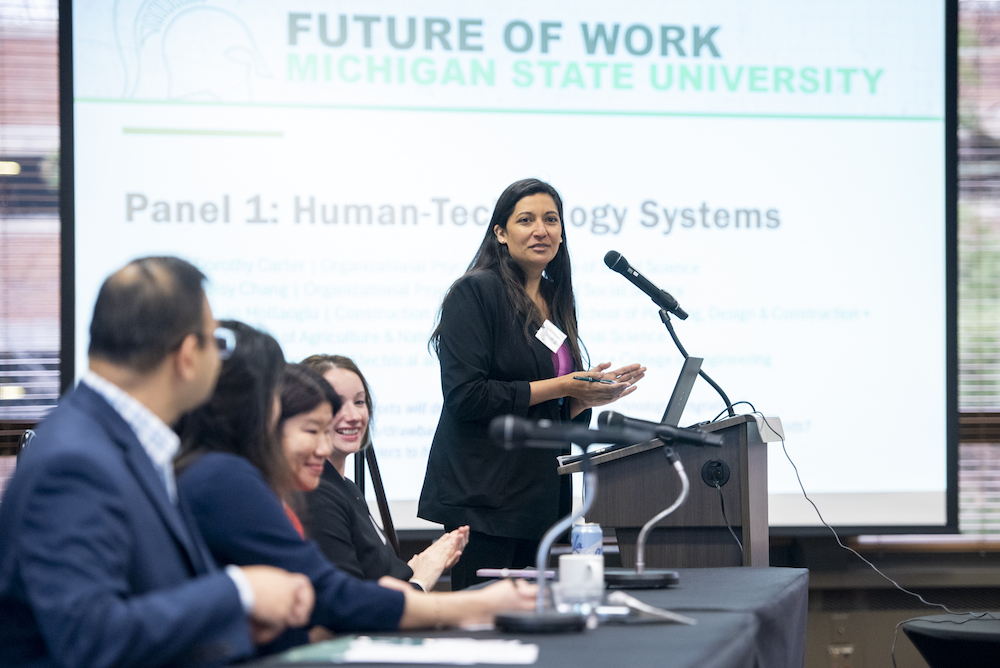
We hosted a convening to bring together researchers, industry leaders, educators, and community partners to drive conversation about how to address challenges related to the changing landscape of work and the rise of AI and automation. Co-organized by Dorothy Carter, Nathan Carter, and Tara Behrend, with opening remarks from CSS Dean Brent Donnellan and Interim Provost Thomas Jeitschko, the day featured flash talks from psychology, economics, geography, law, HRLR, supply chain management, education, construction management, and engineering; and lively discussions from all 70 attendees. Janet Lillie, MSU Assistant Vice President for Community Relations, delivered a keynote that described the landscape of Michigan workforce development leaders. A closing keynote from Dr. Ruth Watkins, President of the Strada Education Network, challenged attendees to re-envision the future of the land grant university and how we can better serve working learners of the future. Additionally, we hosted a poster competition for MSU doctoral students studying future of work topics.

Tara Behrend, director of the Future of Work Initiative, organized the conference convening. She opens the conference providing more background on the iniative.
Past Seminars
- Hye Jin Rho - December 6, 2021
Hye Jin Rho
Assistant Professor
School of Human Resources & Labor Relations
Michigan State UniversityPresentation
Multi-Layered Labor Contracting, Internal Platforms, and Price Setting Process for Non-Standard Work
Abstract
This paper examines an important, but little understood phenomenon that dictates the recruitment of nonstandard workers through what I call "platform-induced multi-layered labor contracting" arrangements. These arrangements occur when a lead company outsources their nonstandard work-specific HR function to an intermediating organization that then contracts with a vendor-managing technology platform to receive bids from a large pool of competing suppliers sourcing nonstandard workers.
In this paper, I examine the link between multi-layered labor contracting, internal platforms, and subsequent economic outcomes for the lead firms, suppliers, and workers. Using unique proprietary data from about a million nonstandard job seeker records at 49 Fortune 500 firms, I first show that the outsourcing of nonstandard worker recruitment is associated with higher returns to the firms and lower returns to the workers. I then find that the arrangements involving internal platforms are by design relationship-limiting — the results reveal that when there are pre-existing firm-worker or firm-supplier relationships outside of the platform, the loss from engaging in platform-induced multi-layered labor contracting is significantly reduced. Findings from this paper shed a new light in understanding the recruitment practices that dictate the price-setting processes for nonstandard work.
- Tara S. Behrend - January 17, 2022
Tara S. Behrend
Program Director
Future of Work at the Human-Technology Frontier: Core Research Program
National Science FoundationPresentation
Keys to a successful NSF proposal
- Emilie Jackson - March 21, 2022
Emilie Jackson
Assistant Professor
Department of Economics
Michigan State UniversityPresentation
New Work or Changes in Reporting? A Framework for Measuring Self-Employment Trends in Administrative Data
Abstract
Increasingly, researchers in the United States look to measures of self-employment from administrative tax data, which show larger growth in self-employment than mainstream surveys of the labor market. This divergence may reflect changes in real activity not well-captured by traditional surveys, but may also reflect changes in workers’ propensity to report their self-employment earnings to tax authorities, potentially in response to incentives created by the tax code. Consistent with the latter explanation, we find the extensive-margin growth in reported self-employment in administrative tax records is concentrated among low-income households with children with incentives to report self-employment earnings due to tax credit phase-ins. We employ a regression discontinuity design which compares households whose children are born at the end of the tax year—and are eligible for these incentives—with households whose children are born just a few days later and face no change in reporting incentives. We find a sizable increase in reported self-employment among incentivized individuals for which the only plausible interpretation is strategic reporting. These effects have grown over time, with increases being concentrated in regions where other proxies for knowledge of tax credits have grown as well. Incorporating these insights, we present a framework to adjust trends in U.S. self-employment tax filings for changes in reporting behaviors to extract true underlying trends in the composition of the workforce. Considering counterfactual scenarios, we find that between 28 and 59 percent of the growth and all countercyclicality in self-employment rates can be attributed to pure reporting changes.
- Amanda Chuan - April 4, 2022
Amanda Chuan
Assistant Professor
School of Human Resources & Labor Relations
Michigan State UniversityPresentation
Non-College Occupations, Workplace Routinization, and the Gender Gap in College Enrollment
Abstract
Women used to lag behind men in college enrollment but now exceed them. This paper focuses on the role of non-college job prospects in explaining these trends. We first document that routine-biased technical change disproportionately displaced non-college occupations held by women. We next instrument for routinization to show that declining non-college job prospects for women increased female enrollment. Two stage least squares results show that a one percentage point rise in routinization increases female college enrollment by 0.6 percentage points, while the effect for male enrollment is not systematically significant. We next embed this instrumental variation into a dynamic model that links education and occupation choices. The model finds that routinization decreased returns to non-college occupations for women, leading them to shift to cognitive work and increasing their college premium. In contrast, non-college occupations for men were less susceptible to routinization. Altogether, our model estimates that workplace routinization accounted for 63% of the growth in female enrollment and 23% of the change in male enrollment between 1980 to 2000.
- Hee Rin Lee - April 18, 2022
Hee Rin Lee
Assistant Professor
Department of Media & Information
Michigan State UniversityPresentation
From Labor-Displacing to Labor-Reinstating: Exploring Production Workers’ Experience with Collaborative Robots
Abstract
Automation technologies have historically been an important site of struggle between laborers and capitalists. These technologies can reduce employment and wages of human workers, and lead to unrest — but they can also create new occupations. Historically, these two effects have counterbalanced each other; however, more recently, economists have expressed concern about automation technologies’ negative impacts on wages and employment. In this talk, I will present how newly-adopted collaborative robots in manufacturing plants generated struggle among various stakeholders and how labor-reinstating technologies can be a promising direction for collaborative robots and other technologies in the future workplace.